Crisis Communication Lessons from Netflix’s Zero Day
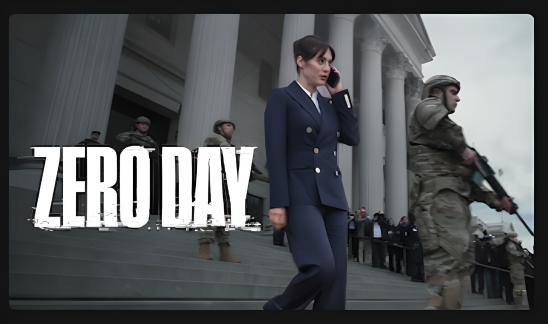
When I saw Netflix’s Zero Day pop up on Your Next Watch, I was intrigued – not just for its star power (Robert De Niro, Angela Bassett, and Connie Britton! Oh my!), but I’m a sucker for a political drama. The limited series imagines a cyberattack that cripples America’s infrastructure, plunging the nation into chaos and forcing leaders to navigate truth, fear, and control in real time.
While Zero Day is labeled as a political thriller, it’s also a powerful case study in crisis communication. For communications professionals, the series offers a dramatized, but relevant, look at how words can stabilize or spiral a crisis. Two moments, in particular, stand out as lessons for anyone responsible for managing messaging under pressure.
Scene 1: “Power, Then Comms”
Late in the series, as chaos unfolds and power is out in the city, Valerie Whitesell (played by Connie Britton), the Chief of Staff for the Zero Day Commission, issues a simple directive to the team:
“Power, then comms. Keep the team focused.”
It’s a brief line, almost throwaway, but it’s also one of the show’s sharpest insights. The moment electricity is restored; communication is next in line.
Because you need power to reach the people.
Whitesell’s line underscores a fundamental truth about crisis management: communication is not a secondary function; it’s essential infrastructure. Once the physical systems are back online, the public’s trust system must be, too. The team can’t instill confidence, guide recovery, or calm panic without strategic, credible, and timely communication.
In crisis situations, whether it’s a system failure or a product recall, communications professionals provide translation and counterbalance. We interpret chaos into clarity, filter noise into direction, and balance urgency with accuracy.
When Valerie says “power, then comms,” she’s really saying: the moment people can listen, we must be ready to speak.
Real-World Application:
For modern crisis communicators, this means preparation can’t wait for the lights to come back on. Clear escalation plans and message templates should already be in place. The first hours of any crisis are the most critical for shaping public perception and preserving trust.
In short, if “power” restores operations, “comms” restores confidence. Both are lifelines.
Scene 2: “The Truth is the Truth”
The series’ final episode features a quiet but powerful exchange between President Evelyn Mitchell (Angela Bassett) and George Mullen (Robert De Niro), the Zero Day Commission chairman whose credibility and experience anchors the investigation. As they discuss the yet-to-be-published findings of his report, the President warns:
President: “When sharing information, what we suspect, what we know, what we can prove, those are all very different things. And ultimately all less important than what the listener is willing to believe.”
Later, the President continues: “People trust you to do the right thing. Whatever you say in that report will be the truth in their minds.”
George: “The truth is the truth.”
President: “Maybe.” She goes onto say, “The truth is the truth, but it’s not always the most important thing.”
It’s a chilling line, especially in today’s world of deepfakes and misinformation. The President’s logic – that belief can outweigh truth – feels disturbingly familiar. And yet, for those of us in communications, it’s a call to push back.
The truth is the most important thing.
Yes, perception shapes narratives. But the communicator’s duty is not to manipulate that perception, it’s to ground it in reality. Once truth becomes negotiable, credibility becomes disposable.
More than a few brand crises have shown that when organizations twist or withhold the truth, a reckoning is inevitable. The fallout might not come immediately, but it always comes, whether through whistleblowers, investigative journalism, or public distrust that never fully fades.
Truth-telling is non-negotiable. It’s not just a moral stance; it’s a strategic one.
Real-World Application:
In corporate communications, professional communicators are often pressured to “control the narrative.” But control should never come at the expense of credibility. There should be transparency, paired with empathy and accountability.
Consider the difference between organizations that admit mistakes versus those that dismiss them. The former may take a short-term hit, but they recover stronger. The latter lose not just reputation, but the trust that makes recovery possible in the first place.
As communicators, our audience may not always believe everything we say but they must always believe us.
The Weight of Words
Across these two scenes, Zero Day delivers a reminder: communication is both a privilege and a responsibility. It’s as vital as power in the wake of crisis, and it’s only as strong as the truth behind it.
When the world feels unstable, whether due to cyberattacks, pandemics, or misinformation, people look to communicators for guidance. That trust is sacred. It’s what gives our words weight and our roles meaning.
So yes, Zero Day may be fiction. But for those of us in the field, it’s also a mirror.
It challenges us to ask:
- Are we ready to speak the moment the lights come back on?
- And when we do, will we have the courage to tell the truth – no matter how inconvenient it may be?
Because in the end, power brings people back online. But truth keeps them believing.
As George states when delivering his findings, “The truth…it can be hard to find and even harder to face. But always worth the effort.”
All images and media are used for commentary, criticism, and educational purposes under Fair Use. All rights belong to their respective owners